The AI Security Imperative
As organizations race to deploy AI systems, a critical gap has emerged between innovation velocity and security maturity. four in five executives named AI-enhanced malicious attacks as the top emerging risk, yet most organizations lack the frameworks and tools to address them systematically. This disconnect creates a dangerous environment where AI systems operate with insufficient oversight, exposing organizations to novel attack vectors, regulatory non-compliance, and reputational damage.
Enter AI TRiSM (AI Trust, Risk, and Security Management), a framework Gartner developed to ensure AI model governance, trustworthiness, fairness, reliability, robustness, efficacy, and data protection.
As generative AI and large language models expand organizations' attack surfaces, AI TRiSM provides the unified coordination necessary to manage these emerging risks.
Understanding AI TRiSM
AI TRiSM operates across four critical layers throughout the AI lifecycle:
1. AI Governance
Establishing visibility and accountability across all AI assets through cataloging, continuous evaluation, and documentation. This layer ensures AI systems comply with regulations and ethical norms while providing the oversight necessary for responsible deployment.
2. AI Runtime Inspection & Enforcement
Real-time monitoring to detect anomalies, policy violations, and security threats during AI operations. This proactive approach identifies problems before they manifest as security incidents or harmful outputs.
3. Information Governance
Ensuring AI systems access only properly classified and permissioned data. This layer reduces exposure risks by implementing data protection methods tailored to specific use cases, particularly critical in regulated industries like healthcare and finance.
4. Infrastructure & Stack
Applying traditional security controls (endpoint, network, and cloud protections) to AI workloads while integrating AI-specific security measures.
Explore AI security with the Scanner Datasheet
The datasheet offers insight into the challenges and solutions in AI security.
Download Datasheet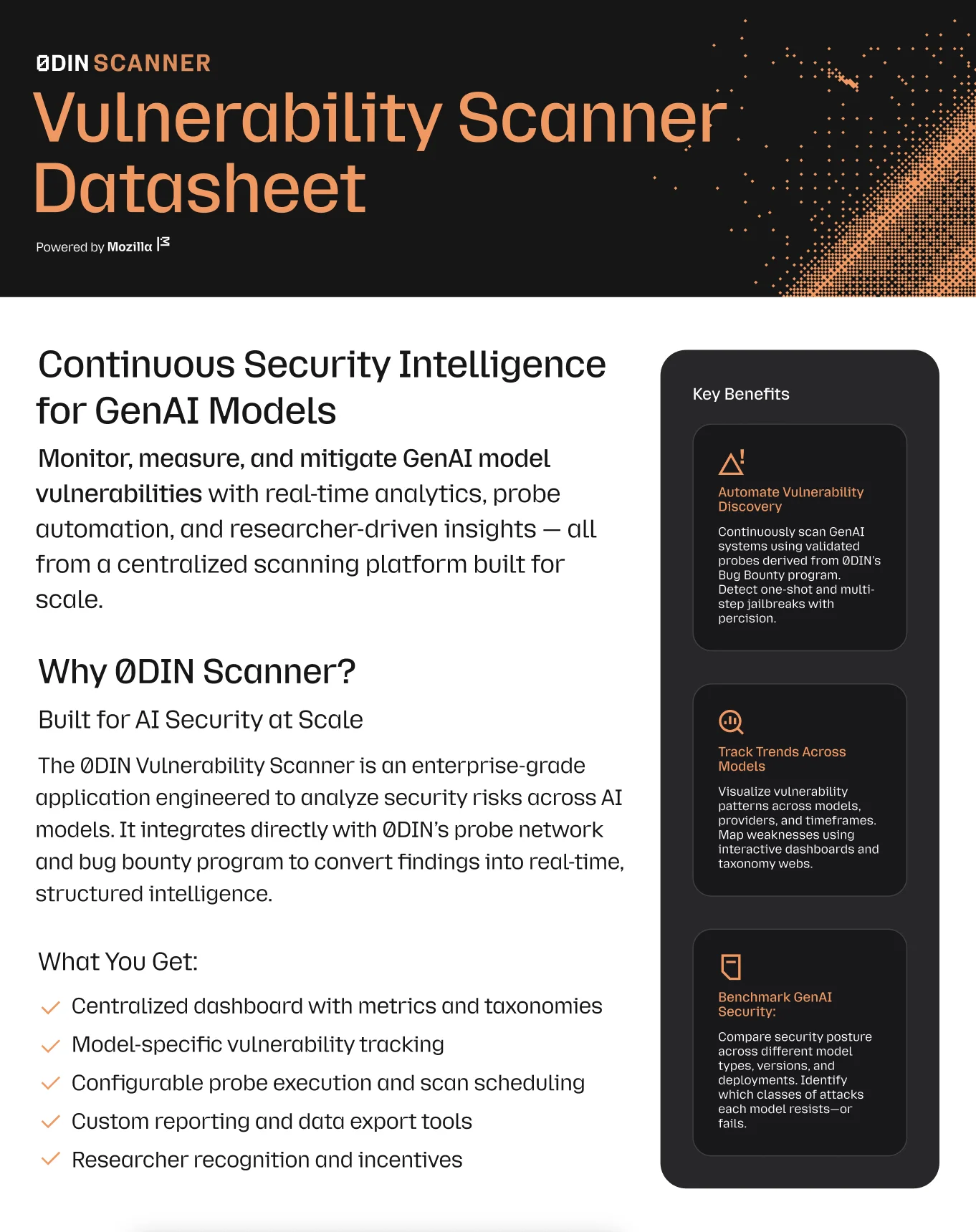
The Threat Landscape Reality
Gartner's research reveals a sobering statistic: Through 2026, at least 80% of unauthorized AI transactions will be caused by internal violations of enterprise policies concerning information oversharing, unacceptable use, or misguided AI behavior rather than malicious attacks.
This finding reframes how organizations should approach AI security. While external attacks on AI systems remain relatively rare, the more prevalent threats include:
- Unconstrained chatbots causing harm through jailbreaks and guardrail bypasses
- Internal data exposure through improper information handling
- Third-party vulnerabilities from AI supply chain dependencies
- Inaccurate or harmful outputs degrading user trust and business outcomes
The challenge is compounded by the fact that only 53% of AI projects make it from prototype to production, often due to inadequate governance and risk management.
Where 0DIN.ai Fits
0DIN.ai (Mozilla's Zero Day Investigative Network) addresses the AI TRiSM framework through two complementary capabilities: threat intelligence feeds and model security scanning.
Threat Intelligence: Real-World Vulnerability Data
Traditional security intelligence focuses on known CVEs and exploit databases. But AI systems face a fundamentally different threat landscape, one where vulnerabilities
often manifest as prompt injection techniques, jailbreak methodologies, and guardrail bypass patterns that don't fit conventional vulnerability taxonomies.
0DIN.ai aggregates threat intelligence from our global network of security researchers who continuously probe production AI systems under authorized bug bounty programs. This research produces:
- Jailbreak pattern libraries documenting techniques that bypass model safeguards across multiple vendors and model families
- Cross-model vulnerability data identifying which weaknesses affect multiple AI systems versus vendor-specific implementations
- Severity scoring via the Jailbreak Evaluation Framework (JEF) providing consistent, quantifiable risk assessment across diverse vulnerability types
This intelligence directly supports AI TRiSM's governance and runtime inspection layers by providing the threat data necessary to build effective detection and policy enforcement rules.
Model Scanning: Proactive Vulnerability Discovery
Beyond reactive threat intelligence, 0DIN.ai provides active model scanning capabilities. These scans systematically probe AI systems for:
- Prompt injection vulnerabilities testing model resilience against input manipulation attacks
- Guardrail effectiveness evaluating whether safety measures function as intended
- Output validation gaps identifying scenarios where models produce harmful, biased, or policy-violating content
- Adversarial robustness measuring model behavior under deliberately crafted edge cases
Scanning aligns with AI TRiSM's emphasis on continuous evaluation and anomaly detection. Rather than assuming models remain secure after initial deployment, regular scanning validates that safeguards continue functioning as threats evolve.
Safeguard Your GenAI Systems
Connect your security infrastructure with our expert-driven vulnerability detection platform.
Implementing AI TRiSM with 0DIN.ai
Gartner predicts that by 2028, 25% of large organizations will have dedicated AI governance teams, up from less than 1% in 2023. Organizations preparing for this shift can leverage 0DIN.ai capabilities across their AI TRiSM implementation:
During Design and Development
- Integrate 0DIN threat intelligence into model training decisions
- Establish baseline security requirements informed by real-world attack patterns
- Define testing protocols using JEF-scored vulnerability categories
Before Deployment
- Run security scans against models before production release
- Validate guardrail effectiveness against known bypass techniques
- Document security posture as part of model documentation requirements
In Production
- Subscribe to threat intelligence feeds for emerging vulnerability patterns
- Schedule regular scanning to detect security drift
- Use JEF scoring to prioritize remediation efforts based on actual risk severity
Continuous Improvement
- Feed scan results back into model improvement cycles
- Track vulnerability trends across model versions
- Benchmark security posture against cross-industry threat data
The Path Forward
AI TRiSM represents more than a compliance checkbox. It's the foundation for sustainable AI deployment. Organizations that treat AI security as an afterthought face mounting risks as regulatory frameworks mature and attack techniques proliferate.
The key findings from Gartner's 2025 Market Guide underscore this urgency:
- No universal solution exists: Organizations must adopt multiple tools for comprehensive coverage
- Organizational silos create gaps: AI TRiSM requires cross-functional collaboration among IT, security, data, and compliance teams
- Traditional security isn't enough: AI-specific controls must complement existing cybersecurity measures
By integrating 0DIN.ai's threat intelligence and scanning capabilities into your AI TRiSM strategy, you gain access to:
- Evidence-based security decisions informed by real vulnerability data from production AI systems
- Proactive vulnerability discovery through systematic model scanning
- Consistent risk assessment via the Jailbreak Evaluation Framework
- Cross-vendor visibility understanding threats that affect the broader AI ecosystem
Conclusion
The organizations that thrive in the AI era will be those that build trust through demonstrated security practices. AI TRiSM provides the framework; 0DIN.ai provides the threat intelligence and scanning capabilities to operationalize it. As Gartner notes, AI's growing complexity demands we move beyond fragmented, ad-hoc approaches to risk management. The alternative, deploying AI systems without comprehensive trust, risk, and security management, is a gamble few organizations can afford to take.